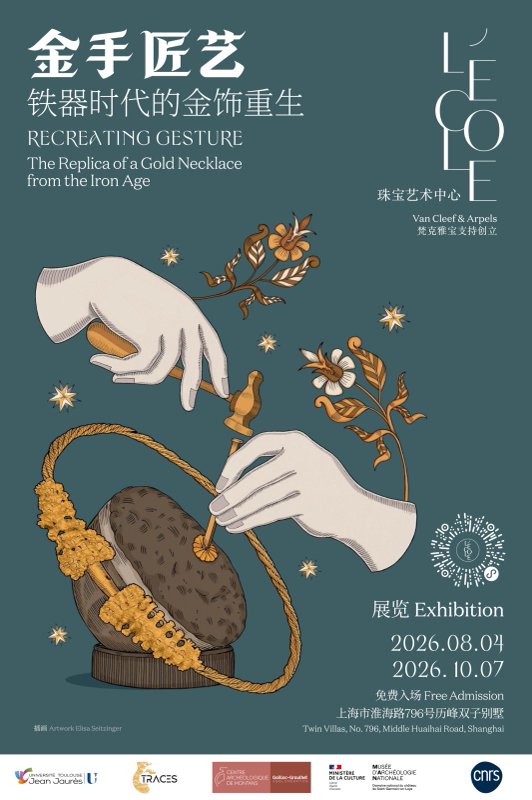
L'ÉCOLE, School of Jewelry Arts, supported by Van Cleef & Arpels, presents the new exhibition "Recreating Gesture: The Replica of a Gold Necklace from the Iron Age" running from August 4th to October 7th, 2026, at the Twin Villas in Shanghai.
This exhibition centers on a remarkable experimental archaeology project: the recreation of a Celtic gold torque, a kind of neck collar, created more than 2,000 years ago.
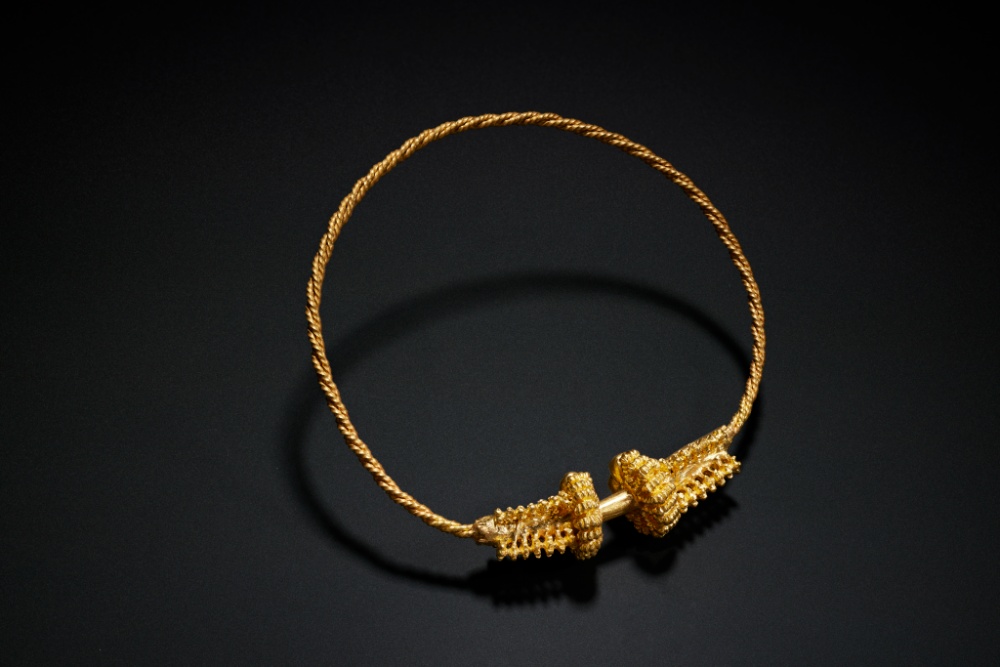
Through the recreation of this ancient ornament, the project seeks to rediscover lost techniques and reveal the savoir-faire of early craftsmen.
To extend the exhibition experience, L'ÉCOLE has also curated interactive education spaces and a series of cultural programs, inviting local audiences to move from observation to hands-on experience, with the heritage of goldsmithing at their fingertips.
Among the many research initiatives undertaken by L'ÉCOLE, the study of the Celtic Torque of Montans stands out because of its multi-temporal and multi-cultural approach. This collaborative project, grounded in experimental archaeology, aims at recreating a Celtic gold torque discovered in 1843, in Montans (France).
Both its form and ornamentation are characteristic of Celtic goldwork and date from the Second Iron Age (450–25 BCE). Composed of intricately twisted gold wires, the original piece illustrates the technical mastery of its time.
This project was initiated by Barbara Armbruster, Research Director at the French Centre National de Recherche Scientifique (CNRS), the Centre Archéologique de Montans and the Musée d'Archéologie Nationale in Saint-Germain-en-Laye, France, and in partnership with Van Cleef & Arpels and L'ÉCOLE, School of Jewelry Arts.
When L'ÉCOLE, School of Jewelry Arts suggested a resumption of the project, the response was immediate and enthusiastic. There was an opportunity to physically examine ancient gold artifacts, and beyond that, to gain a deeper understanding of a Celtic torque dating back over 2,000 years, whose complexity was beyond our modernday comprehension.
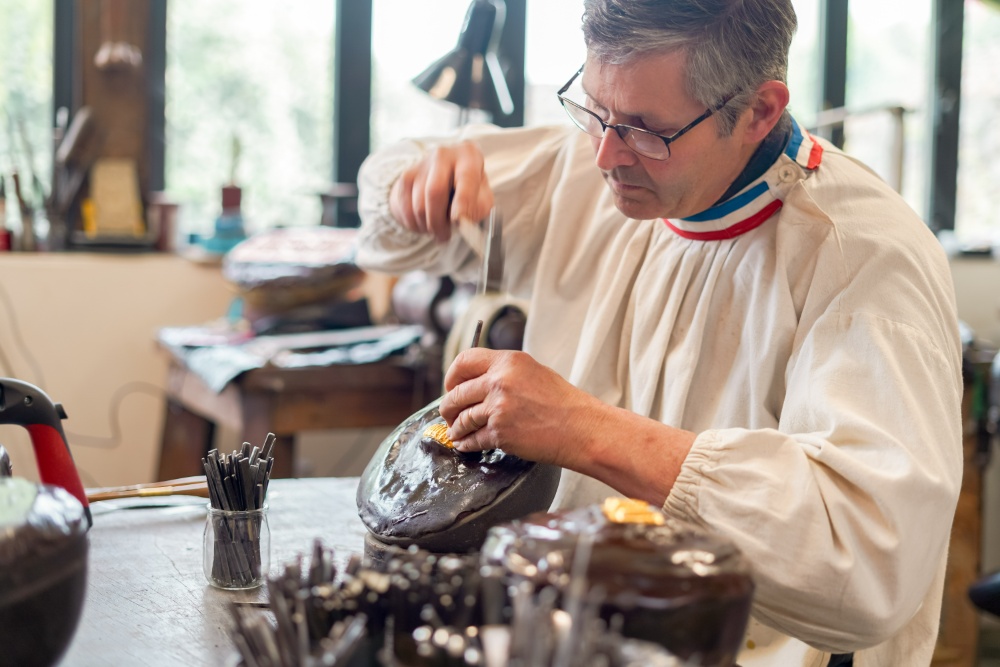
Goldsmith Antoine Legouy, a master chaser acclaimed as Meilleur Ouvrier de France (title awarded exclusively in France, which certifies the acquisition of a high level of qualification in the practice of an activity), collaborated with archaeologists and Grégory Weinstock, Director of Van Cleef & Arpels High Jewelry Métiers, to faithfully recreate and understand these very delicate forms.
Thinking about form through the work of hands was at the heart of the team's shared concerns. Referring to the Celts, Antoine Legouy says that he tried to think from their perspective, and for him the challenge was "to follow in their footsteps" in order to rediscover forgotten techniques.
"What I take away from this experience is the contribution of craftsmanship to the understanding of an object. Research cannot be done without the artisans. Craftsmen's gesture and their knowledge skill are decisive and complement academic studies, and vice versa. This exchange nourishes art history and archaeology, and roots the arts and the techniques in History," said Emmanuelle Amiot, Senior Research Project Manager of L'ÉCOLE, School of Jewelry Arts.