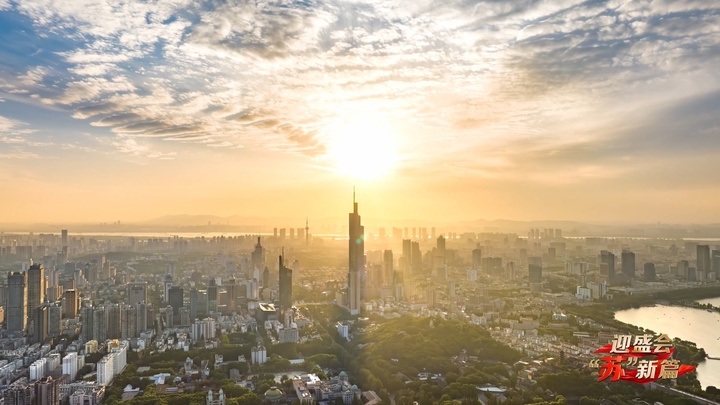
Over the past five years, the gross domestic product (GDP) of Jiangsu Province has crossed trillion-yuan threshold for four times, marking a great leap in its overall development strength.
Statistics show that Jiangsu's GDP exceeded 11 trillion yuan in 2021, an increase of about 1.37 trillion yuan over the previous year — the first time the province's annual GDP increment topped one trillion yuan. The figure climbed to 14 trillion yuan by 2025.
This impressive performance means far more than statistics on paper. It is better reflected in industrial competitiveness and the capacity for translating innovation outcomes into real productivity.
Among its cities, Nanjing has built itself into a key hub for commercializing scientific and technological achievements; Suzhou advances the deep integration of artificial intelligence and manufacturing; Wuxi forges ahead in the integrated circuit sector; Changzhou excels in power batteries, while Nantong boasts strengths in offshore engineering equipment.
In the first three quarters of 2026, growth rates of sectors including integrated circuits and special electronic materials in the province exceeded 20%, and the output of products such as industrial robots and electronic components maintained double-digit growth. The province's total import and export volume reached 5.69 trillion yuan, a year-on-year increase of 29.8%, accounting for 14.2% of the national total.
According to Jiang Zhaoyi, Vice President of the Jiangsu Academy of Finance, a complete, coordinated industrial chain system, and a predictable entrepreneurship ecosystem underpin Jiangsu's efforts to elevate its development quality on top of its economic scale.
Besides, as a major agricultural province and key grain-producing region, Jiangsu contributes 5.5% of the country's grain output with merely 3.2% of China's arable land.
Enterprises are the "cells" of economic development. By the end of 2025, Jiangsu was home to 14.6 million market entities of all types, ranking first in the Yangtze River Delta. Among them were 4.3 million private enterprises, a net increase of more than 600,000 compared with 2022.
A better business environment fuels greater market vitality. In 2025, the province's total retail sales of consumer goods hit 4.6 trillion yuan, marking the first time in 45 years that Jiangsu claimed the top spot nationwide in this indicator.