Participant Information
First Name: Yujia
Last Name: Ding
Self-introduction:
Ding Yujia (male) is from Nanjing. He holds a Master of Fine Arts in Sculpture from Guangxi Arts University and a Bachelor of Fine Arts in Sculpture from the Sculpture and Public Art College of Hebei Academy of Fine Arts. He is a member of the China Sculpture Institute, the China Art and Craft Society, the Nanjing Artists Association, and the Nanjing Sculpture Association.
Design Information
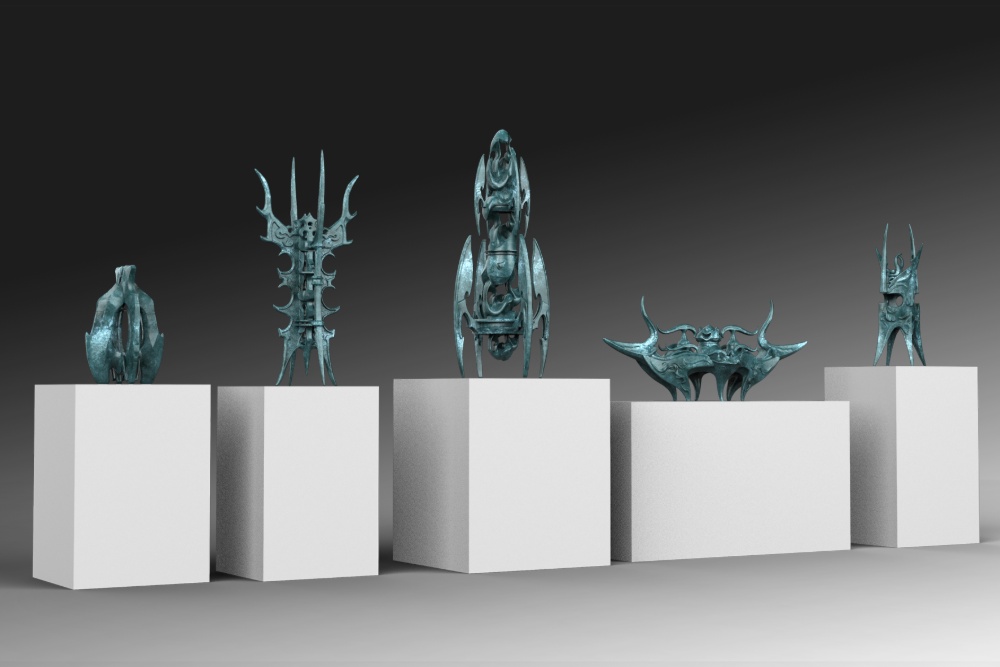
Title: New Bronze Series
Description:
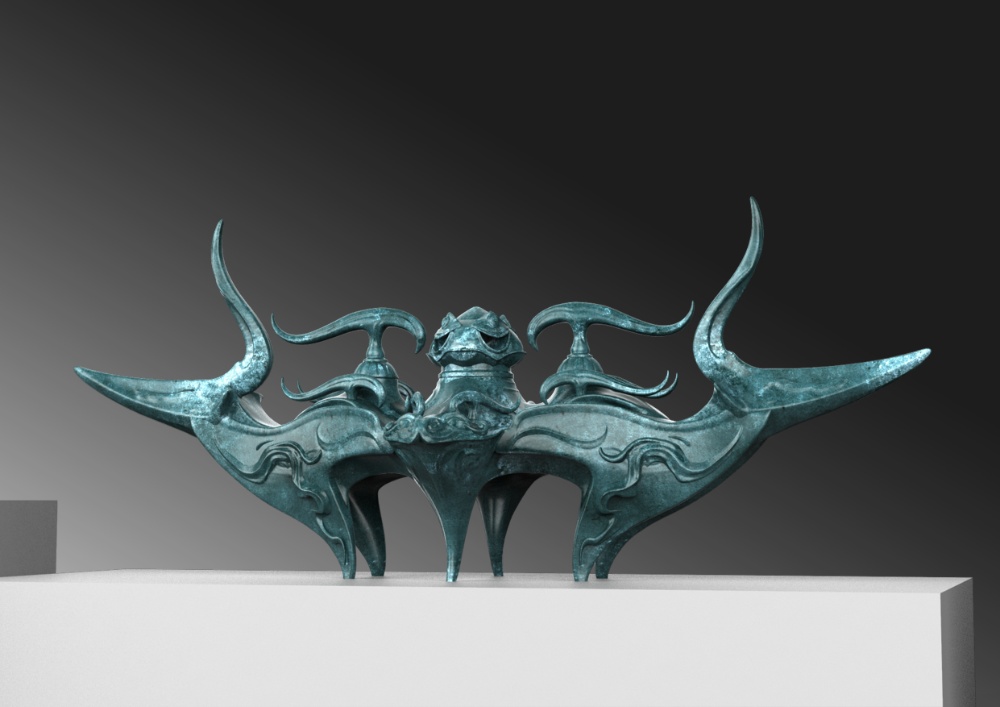
The New Bronze Series draws inspiration from traditional Chinese vessels, transforming the forms of ancient Eastern objects into contemporary sculptures. It deconstructs and reconstructs the symbols of Eastern aesthetics, extending the tradition of these objects in form, attitude, and spirit while integrating futuristic modern sculptural elements. This grants the traditional vessels a new vitality, resembling mysterious carriers emerging from history and striding toward the future, thereby constructing a cultural dialogue that transcends time and space.
The five pieces—Balance, Ascent, Coagulation, Elevation, and Confrontation—form a symbiotic system of "vessel and spirit." Guided by the creative logic of "forms echoing the meaning of words, materials intensifying the artistic conception," the works retain the solid texture and metallic luster of bronze while employing the abstract language of contemporary sculpture to break free from the utilitarian constraints of traditional bronze ware. This transforms them into "tangible cultural symbols."
Through the physical form of the "vessel," the works metaphorically address the philosophical proposition of "moving mountains"—vessels bear not only material weight but also the accumulated weight of civilization. The creative process itself becomes a contemporary version of "unceasingly moving mountains." Adopting a narrative strategy of "seeing the large through the small," it resonates with the ancient concept of "vessels embodying the Dao" (qi yi zai dao).
Innovation manifests in the modern translation of spiritual symbols. Instead of fixating on the transference of matter, the series deconstructs the symbolic meaning of the "vessel," achieving spiritual transcendence through spatial reorganization. It preserves the core of the original spirit while endowing it with an aesthetic form suited to the new era. The series inherits the spiritual essence of traditional Chinese vessels yet breaks through realistic constraints, reconstructing the very concept of the "vessel" with a futuristic artistic language. It creates an aesthetic experience that is both archaic and modern. Using sculpture as a cultural vehicle, it explores new dimensions of artistic expression within the fusion of tradition and the future, connecting the past with what is to come. The aim is to let the vessel be no longer merely a carrier of nostalgia, but to become a "field sculpture" that leverages cognition.